Start with the issuer and the date
Carrier notices are not automatically industry-wide rules. First confirm which shipping line published the notice and the date it was issued or updated. A Maersk advisory should be treated as Maersk guidance for the scope it describes; it does not establish the policy of another carrier. Also distinguish the publication date from the effective date. An item published today may take effect later, and separate countries may have separate start dates.
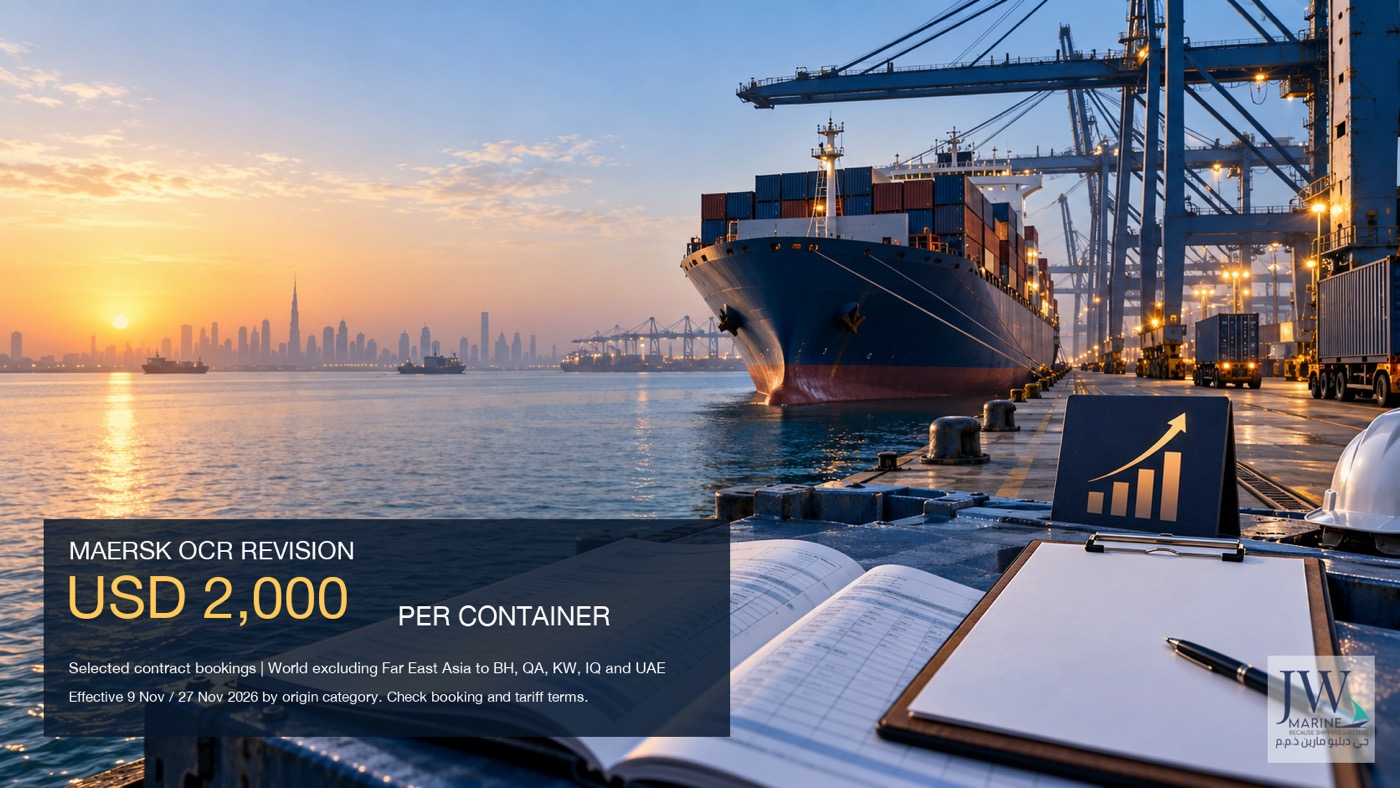
The Maersk OCR notice published on 27 October 2026 is a useful example. It gives an effective date of 9 November for non-regulated countries and 27 November for a list of regulated origins. A buyer who looks only at “27 October” could mistake the announcement date for the date the revised tariff applies.
Read the scope line carefully
Look for origin, destination, cargo type, equipment type and route exclusions. In the OCR notice, the scope is world excluding Far East Asia to Bahrain, Qatar, Kuwait, Iraq and the UAE. The notice lists dry, reefer and special containers, but says the charge applies only to contract bookings. Both details narrow the rule. “Middle East surcharge” is not enough to decide whether an individual shipment is covered.
For an operations advisory, the equivalent scope may be named ports, sailings, bookings, vessels or affected customers. Maersk’s regional operational page describes destination changes for selected Khor Fakkan shipments. The word “selected” and the carrier’s instruction to affected customers mean the public notice should trigger a booking check, not a blanket assumption that every container has moved.
Identify the booking type and calculation basis
Tariff notices may distinguish contract from spot bookings, regulated from non-regulated trades, or one billing basis from another. They may also define a price calculation date. In the OCR notice, Maersk explains different PCD references for non-FMC and FMC non-spot bookings. That means the applicable date may be tied to a scheduled water-leg departure or the last container gate-in date, depending on the regulatory category. Ask the carrier or contracting party to confirm the applicable calculation for the booking rather than choosing the most convenient date.
Understand the unit and what remains outside it
Check whether a rate is per container, per bill of lading, per shipment, per weight unit or per day. Maersk lists USD 2,000 per container. Then check what the amount does not include. The same notice says other applicable surcharges, including local and contingency charges, may still apply. A carrier surcharge is one component of a quote, not automatically the complete cost to move cargo from origin to final delivery.
For total-cost comparison, request a line-by-line quote covering the same origin, destination, equipment, sailing window, services and validity period. Record the base freight, surcharge, local charges, customs-related costs and inland movement separately where applicable. This avoids mixing a changed tariff item with unrelated costs.
Convert operations notices into shipment checks
An operations notice may describe a port change, revised collection location, service suspension, delay or alternate routing. Translate that into practical questions: Does my booking reference appear in the carrier’s notice? Where will the container be discharged? Where will it be available for collection? Is there a bonded inland move? Does the bill of lading or delivery order need updating? Who arranges customs and transport steps? Which charges may change? What is the current estimate, and when should we check again?
Do not send trucks, confirm a customer delivery date or book warehouse capacity using an outdated arrival notice. Ask for a current written instruction and share it with the parties who act on it. If a port or depot changes, verify the physical release location before dispatch.
Maintain a simple record
Keep the original notice, the date it was accessed, the booking reference, carrier confirmation and the resulting cost or routing decision together. If the carrier updates its public page, save the newer version or note the update time. This record helps procurement understand why a quote changed and helps operations identify which instruction is current.
If a notice is ambiguous, ask a narrow question that includes the booking number and the relevant origin, destination, container type and booking category. “Does this surcharge apply?” is less useful than “For contract booking ABC, dry 40-foot container from origin X to UAE, with the first water-leg departure on date Y, does the revised OCR apply and what is the billable amount?” The carrier can then address the actual facts.
Where freight forwarding fits
A freight forwarder can help organize route and cost information, coordinate shipment documents and connect sea, road and customs requirements within the agreed scope. JW Marine describes this coordination through its Freight Forwarding service. A sea movement can be discussed through Ocean Freight; inland arrangements through Transportation; and customs requirements through Customs Clearance. The carrier remains the source for its tariff and shipment-specific operational instruction. JW’s Policies & Terms also explain that transit times are estimates unless expressly agreed otherwise in writing.
The practical rule is straightforward: use a public notice to identify what to verify, then use the booking-specific carrier confirmation to decide what applies. Recheck before acting if the origin, destination, booking type, equipment, date or route changes.
Services are subject to JW Marine’s Standard Terms & Conditions.
Source check: As of 29 October 2026. The Middle East operational update is dated 26 October 2026; the separate OCR revision is dated 27 October 2026. Confirm current tariffs and shipment-specific instructions with Maersk before acting.
General information: This article is not legal or customs advice. Confirm requirements with the carrier, relevant authority or qualified adviser.