What the announcement says
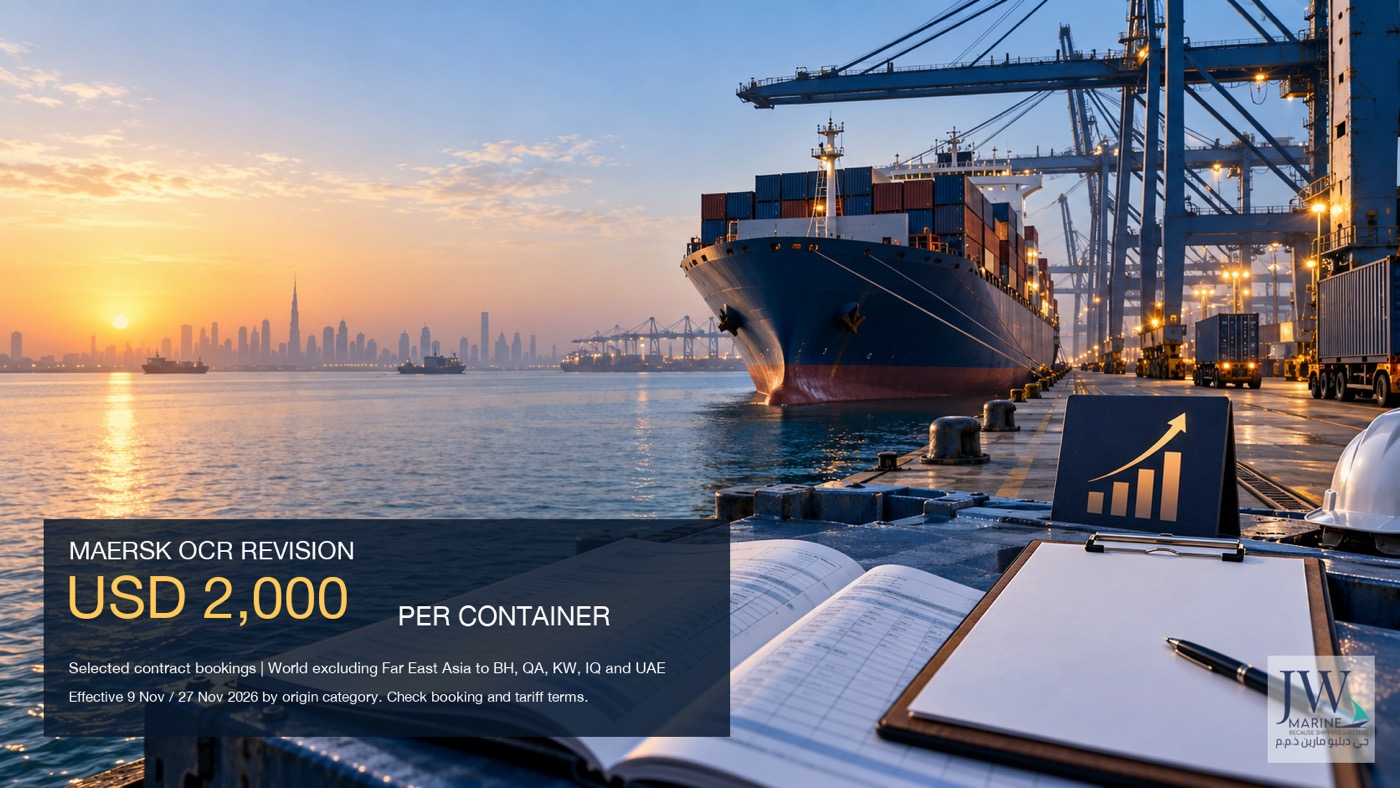
Maersk published a revision to its Emergency Operational Cost Recovery surcharge, abbreviated OCR, on 27 October 2026. The announced trade scope is “World excluding Far East Asia” to Bahrain, Qatar, Kuwait, Iraq and the United Arab Emirates. The notice lists USD 2,000 for dry, reefer and special containers, charged per container, and says the revised surcharge remains in effect until further notice.
That headline amount needs context. The notice says the charge applies only to contract bookings. Therefore, a shipper should not take the USD 2,000 figure and add it automatically to every spot quote or every Gulf-bound container. The correct answer for a particular shipment depends on its booking type, origin, destination, applicable contract and relevant price-calculation details.
The published effective dates also depend on the origin’s regulatory category. For non-regulated countries, Maersk lists 9 November 2026. For regulated countries, it lists 27 November 2026 and names the United States, Guam, American Samoa, the US Virgin Islands, Colombia, Puerto Rico and Brazil. Those categories matter: the shipment’s origin jurisdiction determines which date may apply, not simply the destination port or the date an importer reads the announcement.
In common terms: what is OCR?
OCR is the label Maersk uses for an Emergency Operational Cost Recovery surcharge. In plain language, it is an additional carrier charge associated with operational cost recovery. It sits alongside the freight price and other applicable items; it does not replace the base ocean freight rate or necessarily include all local, contingency, handling, customs or inland transport costs.
Think of a freight quotation as a set of components rather than one number. There may be the main ocean freight, carrier surcharges, origin or destination local charges, and services arranged separately. Maersk’s notice says the published OCR amount is subject to other applicable surcharges, including local and contingency charges. A revised OCR therefore changes one line item in the carrier’s tariff framework; it does not by itself tell the buyer the complete landed logistics cost.
Who may be affected?
The notice is relevant to customers arranging Maersk contract bookings within its stated origin and destination scope. An importer receiving a quote should first establish that the carrier is Maersk, the destination is one of the five named markets, and the origin is within the defined “world excluding Far East Asia” scope. The shipper should then verify whether the booking is a contract booking and which effective date is applicable to the origin country.
The term “contract booking” is central. Maersk’s notice expressly limits applicability to contract bookings. It does not say that every spot booking is covered by the same charge. Do not infer coverage or exemption from a short summary or an old quote. Ask the carrier or the contracting party to confirm in writing how the current tariff applies to the booking reference.
The notice also explains how the amount is retrieved for non-spot bookings. For non-FMC bookings, the PCD, or Price Calculation Date, refers to the scheduled departure date of the first water leg at the time of booking confirmation. For FMC bookings, Maersk says the relevant PCD is the last container gate-in date for non-spot bookings. These definitions can affect which tariff level is retrieved. They are technical tariff rules, so the shipper should not substitute a guessed date such as invoice date, cargo-ready date or arrival date.
Practical checks before approving a quote
Ask for the carrier’s current charge breakdown and verify the booking type, origin, destination, equipment type, effective date and price-calculation basis. Confirm whether the displayed amount is per container and whether the quote separately lists local, contingency or other charges. For multiple containers, check how the carrier applies the per-container rate to each equipment unit; do not assume mixed equipment or split bookings are treated identically without confirmation.
Compare the offer’s validity with the effective date. A quote issued before 9 November could still be governed by booking-specific tariff rules and the stated PCD, so the issue date alone may not decide the amount. If a booking is amended, rolled, split, re-rated or changed in destination, request a refreshed written breakdown. A changed shipment detail can affect the rate or applicable terms.
For financial planning, keep the carrier surcharge separate from the freight rate in the internal cost sheet. This makes it easier to show procurement or finance which component changed and avoids presenting the OCR as the total cost increase. If a customer asks why a quote differs from an earlier one, provide the dated tariff reference and the booking-specific calculation rather than paraphrasing the headline amount as a blanket increase.
What this does not mean
The notice does not announce a surcharge from all shipping lines. It does not cover every origin in Asia because Far East Asia is excluded from the stated scope. It does not establish that the same OCR applies to every cargo movement into the Middle East. It does not say that the amount is due for spot bookings. And it does not provide a complete landed-cost estimate for an individual shipment.
It also does not guarantee that a rate quoted today will remain unchanged until the cargo arrives. The notice remains “until further notice,” and carrier tariffs can be revised. A shipper should keep checking the live tariff and the applicable contract, especially where the planned booking, price-calculation date or shipment details change.
How a freight forwarder can help with the review
A freight forwarder can help organize the shipment facts needed to ask the carrier a precise question: origin, final destination, carrier, equipment, booking type, planned first water-leg departure and relevant contract reference. This is a coordination task; it does not mean the forwarder sets Maersk’s tariff or can promise that a charge will be waived.
JW Marine’s Freight Forwarding service connects sea, air and road arrangements with documentation and onward transport coordination. For a shipment where a carrier surcharge affects the expected cost, a buyer can discuss the overall movement requirements with the team and ask which cost components are confirmed and which need carrier confirmation. JW’s Ocean Freight service is relevant when reviewing the sea leg, while Customs Clearance is a separate consideration for import or export formalities. Transportation can be relevant when the shipment also requires an inland leg.
Before making a booking decision, compare like for like: same origin, destination, carrier, equipment, sailing window, booking type, free-time basis and included services. A lower base freight rate may not be a lower total if it excludes different surcharges or local charges. Conversely, a surcharge revision alone is not enough to conclude that the whole shipping option is commercially worse; compare the full quotation and service conditions.
A simple example without assuming a real shipment
Suppose a buyer is comparing a Maersk contract quote for a container from an origin outside Far East Asia to the UAE with another option. The buyer should first ask whether the 27 October notice applies to that contract and which effective date governs the origin. If it does apply, the quote should show how the per-container OCR is reflected. The buyer should then compare all other line items, including local and contingency charges, and the scope of inland or customs coordination. This example explains the review method only; it does not represent a JW customer shipment or a confirmed rate.
Bottom line for Gulf shippers
Maersk’s 27 October revision is a dated, carrier-specific tariff notice with a defined trade scope, a contract-booking limitation and two effective dates tied to regulatory origin categories. For an importer, the safest next step is to check the exact booking and ask for the current itemized calculation. Keep the OCR distinct from base freight and other charges, and do not apply the USD 2,000 figure beyond the notice’s stated scope.
For shipment planning, use JW’s Contact page to discuss the booking details.
Services are subject to JW Marine’s Standard Terms & Conditions.
Source check: As of 29 October 2026. The OCR notice was published on 27 October 2026. Confirm current tariffs and shipment-specific instructions with Maersk before acting.
General information: This article is not legal or customs advice. Confirm requirements with the carrier, relevant authority or qualified adviser.