Editorial date: 2026-11-09. This article has been assigned a November archive date and was prepared and checked on 26 November 2026. It was not published on the earlier archive date.
Start with the carrier instruction
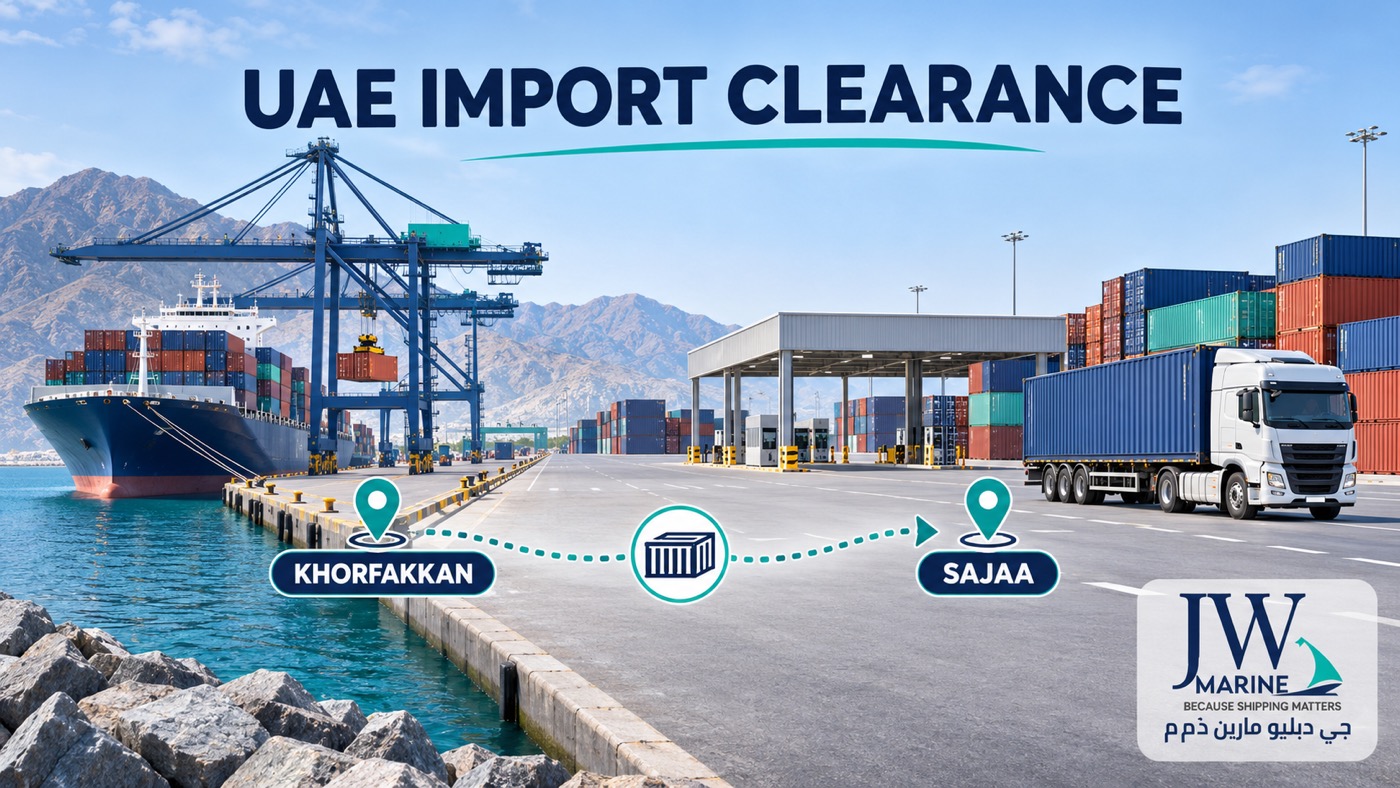
As reported in CMA CGM’s UAE advisory dated 6 November 2026, customers with relevant local UAE cargo discharged at Khorfakkan may request clearance there or at ICD Sajaa. The notice waives amendment and change-of-destination fees for this option while retaining other tariff charges. It describes an online request, different supporting documents for original and sea waybills, and a processing timeline of 96 working hours before vessel ETA. These are carrier-specific instructions, not a universal procedure for every shipping line.
The first task for an importer is to establish whether the option applies to the booking. Ask the carrier or its nominated representative to confirm that point using the bill of lading and container references. Keep the reply with the current arrival information. A port mentioned in a general notice is useful context, but the shipment-specific instruction should decide where the team prepares clearance and collection.
Identify the physical and documentary locations
Write down four locations separately: the vessel’s discharge port, the place where customs clearance is planned, the physical container collection point and the final delivery address. They may be the same or they may differ. Ask the carrier which arrangement is confirmed for each container rather than filling missing details from an older quote.
This distinction helps prevent a common coordination error: a transport order names a port while the release instruction points to an inland location. A warehouse team may also reserve a receiving slot before the container is actually available. Give each location an evidence reference, such as the latest carrier message or release instruction, so everyone can see which details are confirmed and which remain provisional.
Our earlier article on Maersk destination changes explains the broader issue using a different carrier’s notice. It should not be used as the instruction for a CMA CGM shipment. Keep the current carrier’s requirements in the booking file and apply them only within the stated scope.
Check the transport document before submitting a request
Identify whether the shipment uses an original bill of lading or a sea waybill. Under this advisory, the handling differs. Ask the document holder and carrier representative to confirm the exact submission method and any endorsement required. Do this before assigning a runner, courier or transport vehicle; physical document availability can be a different constraint from cargo availability.
Keep a document register with the current version, responsible holder and action status. If an instruction has already been sent, record the time and acknowledgement. Avoid submitting several inconsistent requests from separate departments. A consignee, forwarder and overseas shipper may each hold part of the file, so nominate one person to reconcile the information before it reaches the carrier.
For a general framework on supporting documents, use JW’s Customs Clearance service. That service description does not replace the carrier’s document checklist or the authority’s acceptance decision. If the document type changes, request updated instructions rather than applying the process for the earlier version.
Work backwards from the vessel ETA
The advisory’s 96-working-hour timeline should be treated as a request-planning constraint. Ask the carrier how it counts working hours, which office calendar applies and what acknowledgement confirms that the request is complete. Do not silently convert the wording into four ordinary calendar days, particularly where weekends or holidays sit inside the period.
Set an internal document-ready point ahead of the carrier’s required time. That gives the consignee and document holder room to correct missing information. Keep the estimate and the source timestamp together. If the vessel ETA changes, ask whether the submission remains valid or needs to be reviewed. A fresh ETA can affect transport and receiving plans even where the requested clearance location stays the same.
Do not promise a release date merely because a request was sent within the stated window. Submission, carrier processing, customs formalities, release and physical collection are separate milestones. Agree which confirmation must arrive before the next party starts work.
Compare the full collection cost
A waived amendment or change-of-destination fee does not make the movement free. Ask for the current applicable breakdown, including any terminal, handling, inland transport, storage and clearance-related amounts. Confirm who invoices each item and whether a charge is already included elsewhere in the quote. Keep estimates and confirmed amounts distinct.
For a useful comparison, hold the cargo, equipment, delivery address and required service scope constant. Compare the complete plan for collection at each confirmed location. A lower charge at one stage may be offset by another leg, a different receiving arrangement or additional waiting. The objective is an understandable cost sheet, not a claim that one clearance point is always cheaper.
Discuss the sea leg through Ocean Freight and the confirmed inland movement through Transportation. Request the operational and commercial scope in writing. Neither service page establishes a carrier waiver, a terminal free-time allowance or a guaranteed delivery date.
Control the handover to the truck
Before dispatch, give the haulier the confirmed release location, container and equipment details, collection authorization status and receiving instructions. Ask who checks that the release is usable at the intended location. Where an inland move remains under customs control, have the appointed representative explain the required sequence before the truck is assigned.
Do not reuse an earlier port instruction simply because the container number matches. A destination or collection change can leave old messages in several inboxes. Mark the superseded version clearly in the shipment file and circulate one current instruction to the broker, transport coordinator and receiving team. Keep sensitive shipment references in private operational communications.
If the receiving warehouse cannot accept the cargo at the revised time, resolve that before collection. Confirm the cost and availability of any interim arrangement through the agreed provider. Warehousing & 3PL explains JW’s related service scope, while Freight Forwarding is relevant to coordinating the wider movement.
Use a decision record for each booking
A compact decision record should contain the confirmed option, date of carrier approval, document status, customs representative, collection location, cost breakdown and next review point. Add the person responsible for each unresolved question. This lets another team member continue the work without rebuilding the story from an email chain.
Recheck the arrangement when the vessel, ETA, bill of lading, consignee instruction or delivery address changes. The purpose of the record is to keep the next action tied to current evidence. It should not imply that general information on a public page guarantees acceptance or protects a shipment from every operational change.
Further reading
For related operational context, the Jebel Ali congestion Insight discusses another port. Its reported conditions should not be applied to Khorfakkan or Sajaa.
Discuss the shipment scope
JW Marine can discuss the coordination needed for your cargo through the Contact page. Services are subject to the agreed scope and Standard Terms & Conditions. Before sending shipment documents, review our Privacy Policy.
Common questions.
Is the fee waiver the same as free clearance?
No. The advisory concerns amendment and change-of-destination fees for the described option. Other applicable tariff charges remain; ask for a complete shipment-specific breakdown.
Can the same process be used for another carrier?
Use that carrier’s own current instruction. Similar port names or an inland location do not establish identical document handling, timing or charges.
General information, not legal or customs advice. Source status checked 26 November 2026. Confirm current requirements, cargo acceptance, charges and shipment instructions with the authority or carrier before acting.