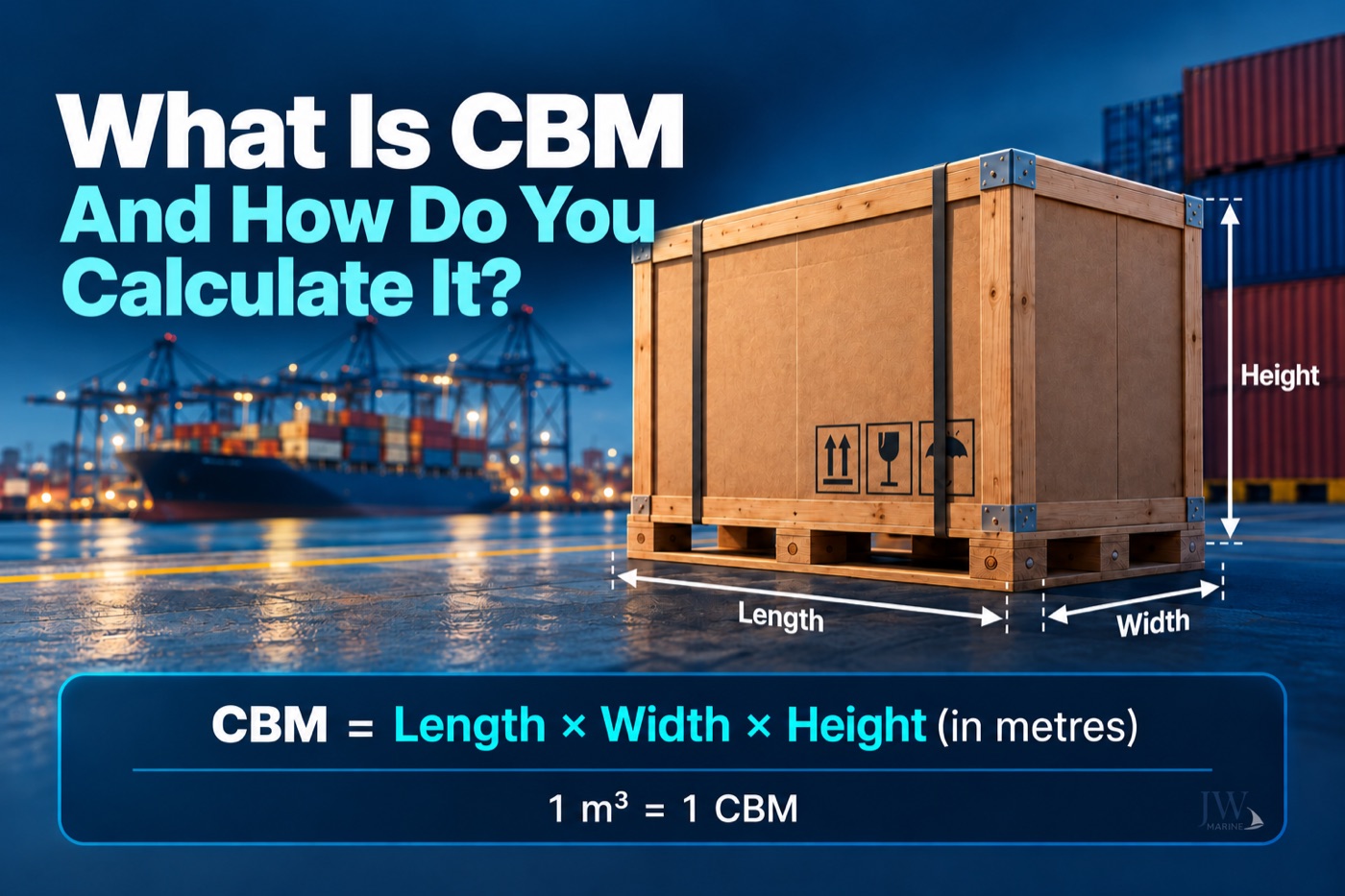
- CBM (cubic metre) is the space a package occupies: length × width × height, in metres.
- With centimetres, multiply the three dimensions and divide by 1,000,000.
- Measure the packed, ready-to-ship cargo, including pallets and packaging.
- Carriers compare volume with weight in different ways for air, sea and road, so always send both.
CBM is one of the first measurements a freight forwarder may ask for when preparing a shipment quotation. It helps describe how much space cartons, pallets or other cargo will occupy in a container, aircraft or truck. It can also be used with shipment weight when a carrier works out the chargeable quantity.
The calculation itself is straightforward: multiply the cargo's length, width and height. The part that needs care is measuring the packed cargo consistently, converting units correctly and understanding how the carrier applies the result to a particular service. To skip the arithmetic, use our free CBM calculator, which also works out volumetric and chargeable weight.
What does CBM mean?
CBM stands for cubic metre (m³), a unit of volume. In freight, it describes the three-dimensional space taken up by a package or shipment. One CBM is the volume of a cube measuring one metre on each side.
CBM is not the same as cargo weight. A compact package of machinery may weigh a great deal while occupying little space. A large carton of lightweight products may weigh much less but take up a substantial part of a vehicle or aircraft. Carriers consider both space and weight when setting rates, although the rules differ by transport mode, route, service and carrier.
How do you calculate CBM?
For a rectangular carton, crate or pallet, use this formula:
All three measurements must be in metres before you multiply them. For example, a carton measuring 1.2 m long, 0.8 m wide and 1 m high has a volume of:
1.2 × 0.8 × 1 = 0.96 m³, or 0.96 CBM
If a shipment contains four identical cartons, multiply the CBM of one carton by the quantity:
0.96 × 4 = 3.84 CBM total
For a shipment with packages of different sizes, calculate each size separately and add the results. If you have three cartons at 0.5 CBM each and two crates at 0.8 CBM each, the total is (3 × 0.5) + (2 × 0.8) = 3.1 CBM.
Converting centimetres to CBM
Many suppliers provide carton measurements in centimetres. Convert each dimension to metres by dividing by 100, or use this equivalent formula:
For a carton measuring 120 × 80 × 100 cm:
120 × 80 × 100 ÷ 1,000,000 = 0.96 CBM
This gives the same answer as converting the dimensions to 1.2 × 0.8 × 1 m. Keep the original measurements and the converted result in your shipment records so the calculation can be checked later.
How should you measure cargo?
Measure the packed, ready-to-ship package, not only the product inside it. Include the carton, protective material, pallet, crate or other packaging. Measure the longest outward points on each axis. If cartons bulge, wrapping protrudes or a pallet has overhang, those extra dimensions can affect the space the cargo occupies.
For palletised freight, measure the overall length, width and height from the floor to the highest point of the loaded pallet. Include the pallet itself. Do not assume every pallet has the same height or that a shipment will fit within the pallet footprint after loading.
For irregular cargo that cannot be measured as a neat cuboid, ask the freight provider how it wants the dimensions recorded. A common estimate uses the maximum length, width and height, which gives the smallest enclosing rectangular volume. For a cylindrical item such as a pipe or roll, geometric volume can be estimated as π × radius² × length; however, a carrier may rate the cargo using its outer handling dimensions instead. The carrier's measurement method governs the quotation. Heavy or oversized pieces are usually planned as project cargo.
Does CBM determine the freight charge?
CBM can affect freight cost, but it is not a universal price formula. A carrier may rate a shipment by actual weight, volume, a combination of the two, a minimum charge or a tariff-specific measure. The applicable basis can also change between air, sea and road services.
Air freight: compare gross and volumetric weight
Air freight commonly compares the shipment's gross weight with its volumetric weight. Gross weight is the packed shipment's actual weight. Volumetric weight converts package dimensions into a weight equivalent using a divisor set by the airline, service or tariff.
When dimensions are in centimetres, a commonly used example is:
Some services use a divisor of 6,000; others may use a different figure. Always confirm the divisor and rounding rules for the quoted service. The airline generally rates using the higher of gross weight and volumetric weight, often called the chargeable weight.
For example, a 120 × 80 × 100 cm carton has a volume of 0.96 CBM. With a divisor of 6,000, its volumetric weight is 160 kg. If its gross weight is 100 kg, the dimensional figure is higher. If the actual service uses that divisor and rates on the greater figure, 160 kg would be the starting chargeable weight before any applicable rounding or minimums. This example is illustrative; the carrier's tariff controls. You can change the divisor in our CBM calculator to compare gross, volumetric and chargeable weight for your own cargo.
Sea freight: LCL measurement and weight
For less-than-container-load (LCL) sea freight, cargo from multiple shippers shares container space. The quote may use a weight-or-measure basis, often abbreviated W/M: the carrier compares the shipment's weight with its volume according to the applicable tariff. Minimum billable quantities, density rules, handling requirements and local charges may also apply. Our guide to consolidated LCL services explains how sharing a container keeps costs down.
For instance, a shipment measuring 3.84 CBM and weighing 400 kg could be assessed differently from a dense shipment with the same volume but much higher weight. Do not assume that every LCL carrier uses the same conversion or that the base ocean-freight line is the full landed cost. Ask which rating basis applies and whether origin, destination, documentation and handling charges are included.
For full-container-load (FCL) shipments, CBM remains useful for planning how cargo fits inside the container. Actual usable capacity depends on the container type, internal dimensions, payload limit, packing arrangement and loading constraints. A theoretical volume calculation does not guarantee that every carton will fit safely or efficiently. Compare the options in our overview of container types and sizes.
Road freight: check the route and operator's rules
Road freight providers may consider cargo volume, loading metres, pallet spaces, actual weight or a density conversion. The rules can vary by country, route, vehicle type and whether the shipment is part-load or full-load. Share accurate dimensions and weight when requesting a quote; a CBM figure alone may not be enough to confirm the rate. For cross-border moves, see when to choose FTL or LTL road transport.
Businesses moving cargo across the UAE or to nearby markets can discuss routing and handling options through JW Marine's transportation services and freight forwarding services.
Common CBM calculation mistakes
- Mixing units: Multiplying centimetres directly without dividing by 1,000,000 produces a result that is one million times too large.
- Using product dimensions: Freight measurements should include the final outer packaging and pallet, where applicable.
- Ignoring package quantity: Calculate each package or size group, then multiply by its quantity.
- Measuring only the pallet base: Include the full loaded height and any overhang.
- Assuming one chargeable-weight rule: Air, sea and road providers may apply different divisors, tariff units and rounding rules.
- Treating CBM as the full freight quote: Freight quotations may include separate transport, handling, customs, documentation and destination charges.
Accurate measurements can help a forwarder select a suitable service and reduce avoidable quote changes when cargo is checked. If the cargo requires special handling, has an unusual shape or is stacked on non-standard pallets, share photographs and package details along with the dimensions.
For shipments involving import or export formalities, JW Marine can also support the movement with customs clearance services. Cargo that needs temporary storage or coordinated distribution may benefit from warehousing and 3PL services, while time-sensitive shipments can be reviewed through air freight services.
Plan your shipment with accurate measurements
CBM is a simple way to describe cargo volume: multiply length, width and height in metres, then total the packages. Its role in pricing depends on the carrier and transport mode, so provide both dimensions and weight when comparing options. Clear measurements help your logistics team assess space, handling and service requirements before the cargo moves.
Calculate your shipment now with the JW Marine CBM calculator, then contact JW Marine to discuss a suitable freight forwarding option.
Common questions.
Is CBM the same as cubic feet?
No. CBM is measured in cubic metres, while cubic feet is another unit of volume. Convert all dimensions into one unit system before calculating. One cubic metre is approximately 35.315 cubic feet.
Can I calculate CBM in centimetres?
Yes. Multiply length × width × height in centimetres and divide the result by 1,000,000. For example, 100 × 100 × 100 cm equals 1 CBM.
Does a higher CBM always mean a higher freight bill?
Not always. CBM may influence the chargeable quantity, but the final amount depends on the mode, route, service, actual weight, carrier tariff, minimum charges and other fees. Request a quote using both dimensions and gross weight.
What information should I send for a freight quote?
Provide the origin and destination, number of packages, outer dimensions of each package or size group, gross weight, cargo description, packing type and any handling requirements. For pallets, include the complete loaded dimensions.
Is there a quick way to calculate CBM for many packages?
Yes. Our free CBM calculator lets you enter packages one by one or paste a whole packing list, and gives the total CBM, gross, volumetric and chargeable weight, with a copy button for the result.